
P2P editions › The Meuse from top to bottom
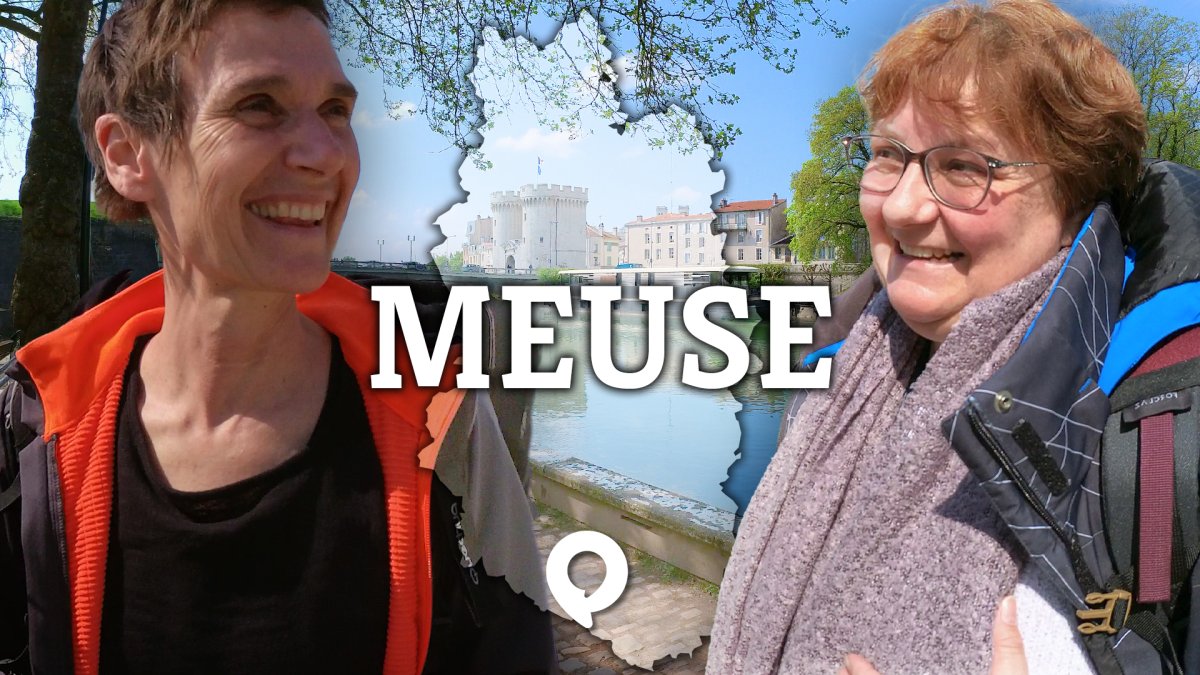
The Meuse from top to bottom
This time we're travelling with our mums! Nicolas and Lou take Florence and Cathy to discover a department they had never been to... Discovering France's “empty diagonal”: the Meuse!
Both pairs left Nancy at 8 am on Wednesday 27 April and returned on the evening of 28 April, travelling only by hitchhiking.
The video
The video is hosted on YouTube and only loads when you click.
The route map
Words and pictures tell the emotion, but geography tells the effort. To see the full scale of the journey and its detours, explore the exact route they took and where each challenge was located.
Good to know: you can interact with the map to show or hide the challenges and routes. Hide the list of challenges if you want to try them yourself!
Portraits 2 Passages — The Meuse from top to bottom
The challenges
Can you take on these cultural challenges like they did? Test your knowledge of the region with the riddles below.
The Flamboyant Gothic — A stone's throw from the Belgian border, a masterpiece of carved stone still intrigues historians.
The Basilica of Notre-Dame d'Avioth is a 14th-century Gothic Catholic basilica in the former county of Chiny (now the north of the Meuse department), in the commune of Avioth. It has been a listed historic monument since the first list of 1840. Because of its size, the church is also called “the Cathedral of the Fields”.
The Verre d'Ain — After the horrors of war, it was time to set aside a space to think about peace.
The Verdun Memorial is a museum devoted to the history and memory of the 1916 Battle of Verdun, located in Fleury-devant-Douaumont, a few kilometres from Verdun, in the Meuse department (Grand Est region).
The Limestone — These seven great ladies offer us a lovely walk, even though they never move.
The Dames de Meuse — seven of them, like the Seven Sisters of Norway — are a favourite walk of the people of Saint-Mihiel. The first, called the Calvary Rock, is the site of an annual pilgrimage on the evening of Good Friday. A grotto carved into the rock shelters an entombed Christ by a local artist named Mangeot.
The Tower — Centrepiece of the town's defences, then a prison, then a historic monument: what a story!
The Tour des Plaids in Verdun. Built in the 14th century, it is part of Verdun's Great Rampart. Horseshoe-shaped, it is also called the Tour du Puty. The name “Plaids” comes from the court hearings held there in the Middle Ages.
The Stanislas — It was one of the favourite residences of the deposed king of Poland.
The Château de Commercy, in Commercy (Meuse), was once the seat of a sovereign principality that passed to Charles-Henri, Count of Vaudémont, legitimised son of Duke Charles IV of Lorraine. The château has been a listed historic monument since 1960, and its outbuildings since June 1972. In 1744 it became the property of Duke Stanislas Leszczyński; the former king of Poland made it one of his favourite residences.
The Citadel — French since 1659, it now houses a museum of painting and naturalism.
An exceptional natural and historic site, the Citadel of Montmédy is one of the largest fortresses in the Grand Est, with more than 1.5 km of walls open to visitors.
The Renaissance — In the capital of the “Common Lands”, you can still admire the façades of old town houses.
Bar-le-Duc, Meuse.
The Escape — Go to the village where King Louis XVI was arrested on 21 June 1791.
Varennes-en-Argonne. The failed escape of 20–21 June 1791, better known as the “Flight to Varennes”, is a key episode of the French Revolution: King Louis XVI, Queen Marie-Antoinette and their immediate family tried to reach the royalist stronghold of Montmédy, from which the king hoped to launch a counter-revolution, and were arrested on the way at Varennes-en-Argonne (Meuse, Lorraine).
The Ornain — For a long time, it was the town's only bridge. In the middle, you'll find an oratory chapel.
The Pont Notre-Dame is a five-arch masonry bridge across the Ornain in Bar-le-Duc, in the Meuse department, Lorraine.
The Obelix — Big, imposing, ready to fall on our heads... Find these giants under which a few Romans may have been squashed.
Several sites are possible; here is a non-exhaustive list: • Pierre de la Dame Schone in Saint-Mihiel • Woinville menhir in Buxières-sous-les-Côtes • Mécrin menhir in Mécrin • Hotte du Diable in Milly-sur-Bradon • Le Corrois menhir in Montplonne
The Atomic — It's a special zone — a zone of struggle and of ideas worth defending.
The Cigéo project aims to bury highly dangerous radioactive waste deep underground at Bure (Meuse). The site is expected to receive its first packages of radioactive waste in 2030. Despite strong opposition (from associations and local residents), the Constitutional Council ruled, in a decision handed down on Friday 27 October, that the Cigéo deep-burial project at Bure complies with the Constitution.